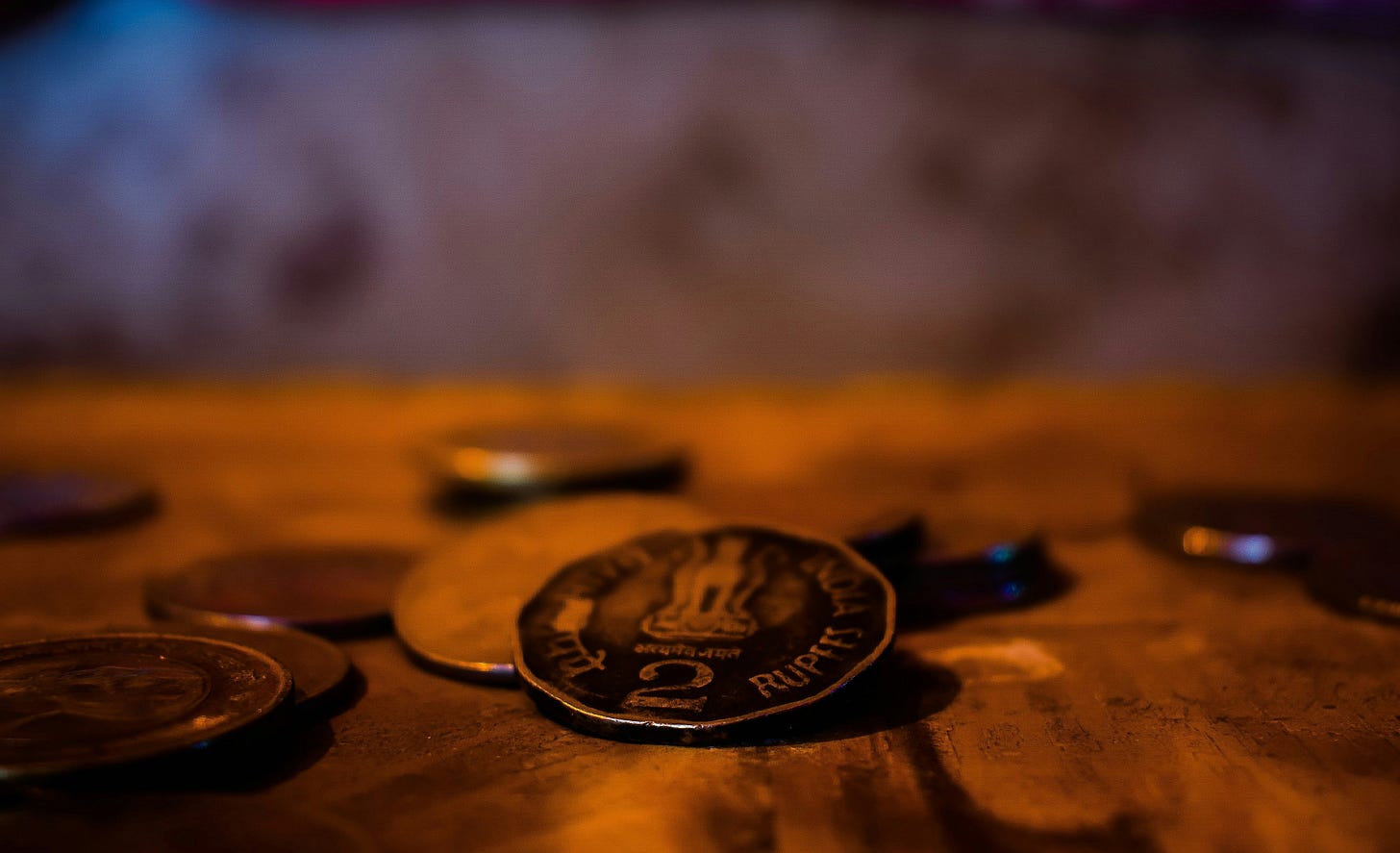
In a dim back alley in Beijing, my step father was clutching the $1000 in his wallet, grimacing, as we strained to see the three 1800s coins a tattered man was holding out to us. If they were real, they would be worth $50,000. If they were fake, nothing.
We had met the man in the market yesterday, left to consider at the hotel, and now we stood in a room with pants and shirts hanging from the walls to dry, a bed rolled in a corner, and two small faces peering out at us from a cubby in the back of the room. His home.
Now we were back for the final decision. Were they worth most of my step father’s cash?
Were the coins authentic?
What Even Is Authenticity?
We talk a lot about trying to live authentic lives, be authentic people, build authentic businesses.
What do we mean?
It’s a matching process. On one hand, there’s a version of ourselves that we have in our head: a version in line with our values, that’s honest, that moves with integrity, and has an integrated, functional worldview. It’s a version that’s able to habitually react in a way that we approve of.
On the other hand, we have what we actually do in the weird circumstances that life throws at us.
When we’re trying to be authentic, we are comparing them. Does the outside version, the behavioral version, the visible version – match the internal version?
But to match the two sides, we need two points of contact. An internal side, and a reflected side. Both.
Introspection Alone Doesn’t Make You Happy
Personally, I love introspection. I love reading philosophical, spiritual, and psychological stuff and thinking about how it applies to my life. I love journaling and working through things internally. I make art and walk to process.
And that is where I’ve spent most of my life. I have spent countless hours working toward internal clarity and internal integrity.
And I still felt like sh*t.
It felt like my life had no meaning.
Because my behavior was not evidence of all of that internal work I had done.
I wasn’t being authentic. I was cooking and cleaning and working and wiping butts and sustaining human life (I’m a mom). But I felt empty.
I felt like there was nothing for me in my life, because all of the internal stuff that I had done was not coming out in behavior. There was no place in my life where it was visible, where I could use it and do things related to it.
It wasn’t until I started writing and sharing all of my internal milieu (here, on Substack) that I felt aligned and authentic and alive for the first time in many years. Finally, my outside behavior is matching my inner life. I’m authentic.
When Do We Notice Authenticity?
On another level, we absolutely need the introspection. We need the process of wondering: What do I really value? What do I really think? What do I feel about that?
We also need to do the work of questioning and filtering out the beliefs we’ve picked up along the way that aren’t uniquely true for us. We have to question the dominant worldview and rebuild it into something that is coherent for ourselves, something that feels right.
Internally, I am asking things like: is this right, true, good, meaningful, helpful?
But I don’t ask “Was I authentic?” until I’m thinking about a behavior with some other sentient being.
If I’m alone meditating on my porch, I’m not asking, “Am I authentic?” I’m just existing.
But if a squirrel starts yelling at me, there’s a risk it’s going to wake up my kids, and I have to decide how to react to this angry squirrel, then I have questions about authenticity. Is it aligned with my values to shake a broom at it?
Introspection – finding what is authentic – is only half of the equation.
The other half is behavior: how you act, how you choose to be seen, how you use that internal state that you worked so hard to find.
Society Accepts the Lowest Common Denominator
This project of having an authentic life is also complicated by the fact that our practical daily lives, and society itself, are structured in many ways to overlook our inner lives completely.
Being authentic to your values, your morals, your inner state is often not called for in the work we spent most of our time doing.
Authenticity isn’t a requirement for coding a program at work, making dinner for the seven-millionth time, or flipping burgers at McDonald’s.
Life will accept the lowest common denominator.
Even if we feel like crap doing it.
It’s up to us, to our own agency, to figure out creative ways to become more authentic. To bring more of our inner lives into our behavior. To figure out what our values are and then how to live in accordance with them.
And the best way to do that is in community.
Community Is Our Mirror
Humans are relational beings. We pretty much always exist in some kind of relationship with eachother, and even a hermit exists in relationship with the ecosystem that keeps him alive.
If we don’t bring our internal stuff outside, it’s not filtering through to our behavior. We aren’t really living AS who we believe we are in our heads.
If other humans don’t see it – we don’t develop the mirror that lets us see ourselves.
Our people reflect back to us who we are, who we are being, and if we are pulling off something like human decency in the complex web of reality.
They may not agree or like how we are acting. But showing them who we really are is essential to being authentic to it – even though it is sometimes costly.
Community Opens the Door to Deeper Solutions
After staring at the coins for what felt like a very tense hour, finally I noticed that two of them had the same flaw, a little pair of tiny lumps near the president’s nose.
The coins were inauthentic.
My stepfather kept his money, and the two little kids in the back room probably did not get a new pair of shoes.
But was it a win?
When I think of that story, I always think of the eyes of those two little kids watching me from the back of the room. They were obviously very poor. I think of what a life-changing difference that much money could’ve made to their family.
I figured out “the truth”, in that situation. But I didn’t create a win-win. I didn’t do anything about someone else’s suffering.
I don’t know if I was authentic.
Honestly, society helps create the situations we are trying to be authentic in. And reacting to and resolving those situations, in accord with our highest values, is often something we need other people for. Both to help us see ourselves and to help us create deeper solutions.
The Project of Building an Authentic Life
Being authentic is a lifetime-sized project. It’s not something you do once and somehow “achieve”. It involves layers of choices, repetition, and impacts that we can’t necessarily control.
But having a life that feels meaningful, that feels worthwhile, that feels good on the inside, depends on us determining what is authentic for us, what our highest values are, and then trying to live in accordance with them.
Even if that means rearranging our whole lives. Even if that means writing on the Internet and building a business so that you have the freedom to choose what is authentic. Even if it means making hard choices that affect other people.
Even if it means building communities so we can support each other in doing the right, authentic things, even when they’re hard.
You can’t be authentic in a closet. It’s relational.
Thank you for being here for my authenticity.
Here’s to yours.
– Morgan
You might like this one too, also on visibility and authenticity:
Leave a Reply