Imagine it’s the second century C.E. You’re a Viking. You’ve been living with your family in a dirty long house for months and months on end.
It’s late winter – the food stocks have long since run low, the hunger gnaws constantly in your belly, and the pathetic fire barely touches the constant cold that has soaked into your bones.
You know you’re hungry. And you’re slowly coming to the realization that, if someone doesn’t go out into the frozen forest and hunt, it’s likely that you won’t make it through this winter. It’s longer and harder than you expected.
But whoever goes out hunting is likely to die. Sven went out last week and hasn’t been heard from since.
And even the successful hunters often come back missing fingers and toes. You wiggle your fingers over the fire, feeling the ache of cold. Wondering which ones you’d prefer to lose for a meal.
The tension as your wife brings out the last meal is palpable. The food stores are gone now. After these last few scraps, you’ll be down to boiled leather.
What do you do?
An Ancient Map for Resolving Tension: Runes
The runes were invented by Germanic peoples nearly 2000 years ago.
While they were used for cool things like writing and graffiti, each rune also has its own meaning attached to it, and that allows it to be used for tasks like divination and self-understanding as well.
The Vikings have a lot to tell us about the process of holding tension because they spent a lot of time living in exceptionally crappy situations with no quick fix.
These were people who spent all winter cold and nearly starving every year, in a good year. Historically, they lived in very cold, unwelcoming tracts of land, where it was hard to grow crops, where winter was severe, and the people who survived the disease and starvation spent a lot of time killing each other.
They were well accustomed to being fundamentally aware that things need to be different, longing for something else, realizing the heavy sacrifice change would require, and enduring the slow process of becoming.
Which is why the runes are such a valuable window into the process of holding tension today.
There are 24 runes in the Elder Futhark – the runic alphabet – and many of them have important lessons for enduring and resolving tension. But for our purposes, we’ll focus on four.
Nauthiz. naw-deez. Need.
Nauthiz highlights the tension that comes into us when we want something and we know we can’t have it yet. We begin to realize a need, a lack.
Think of our Vikings’ gnawing hunger. For months on end, sitting around the fire, it became slowly and increasingly obvious that there was not quite enough food.
In our case, that might look more like a goal, a relationship, a job, or a state of being – like happiness. We become increasingly aware that we want it and need it, but it is most definitely not here.
This isn’t an empty state, though.
What Nauthiz asks of us is first to identify what you truly need. What are you really willing to risk your life for? Would you risk frostbite hunting elk in the frozen north?
I think of the Donner Party. They were a group of American settlers in the 1840s who were trapped in the mountains, starving in the snow, and many of them died. But they made several forays to walk out to safety. Imagine the calculus they had to make – abandoning loved ones to walk hundreds of miles in deep snow while starving, or doing nothing and waiting to die together.
There are times when all of the options are bad. And we have to dig deep and find our values, find what we hope will work, and then roll the dice.
You’ve realized that you have a need, and you realize it’s going to cost you to meet that need, but you’re not sure what it’s going to cost or how much you’re willing to pay yet. It’s the rune of coming to terms with those decisions.
This stage asks you to decide what you’re willing to lose or risk to fix the tension. What will you have to become to do what has to be done? And are you really willing to pay that price?
Isa. ee-sah. Ice.
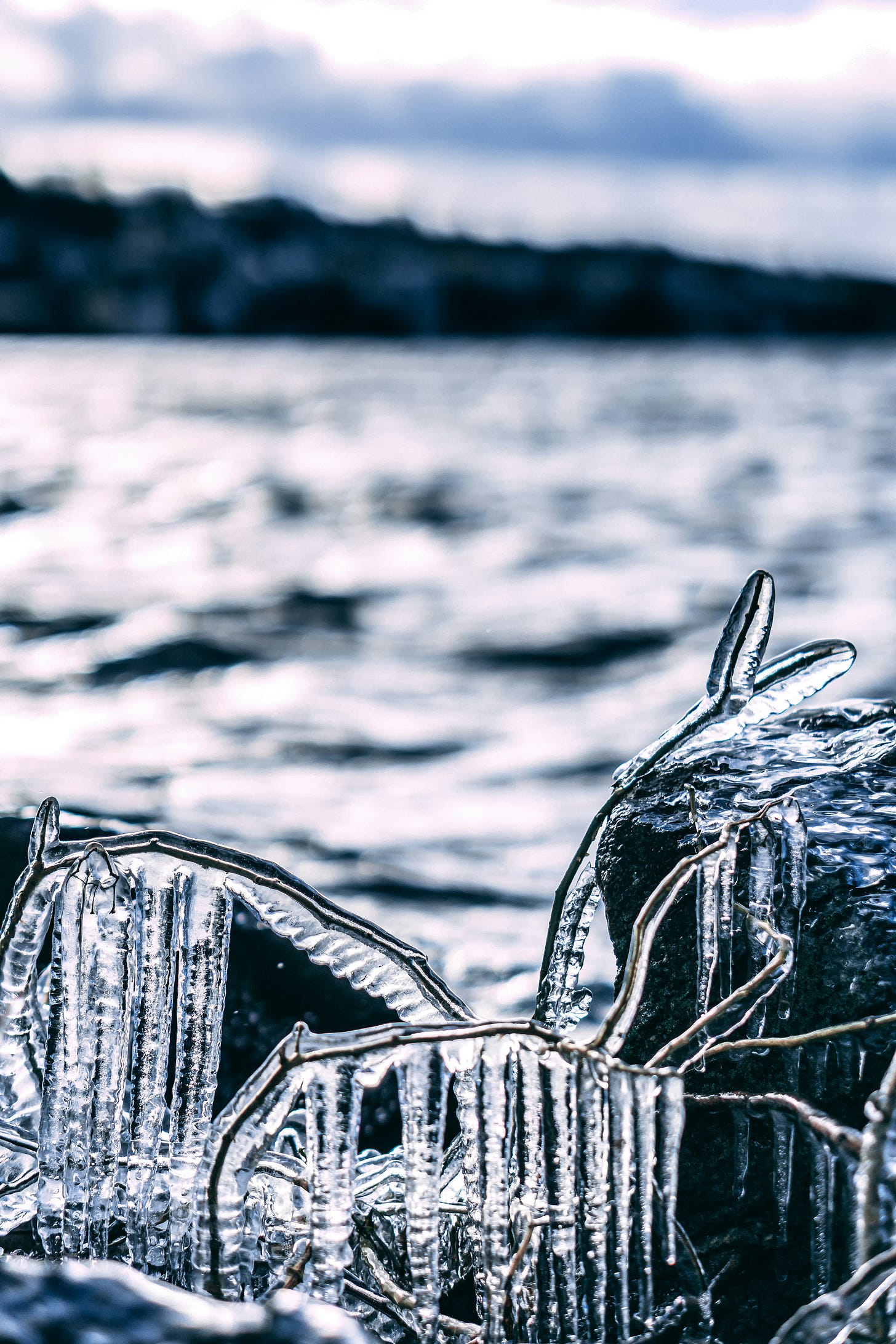
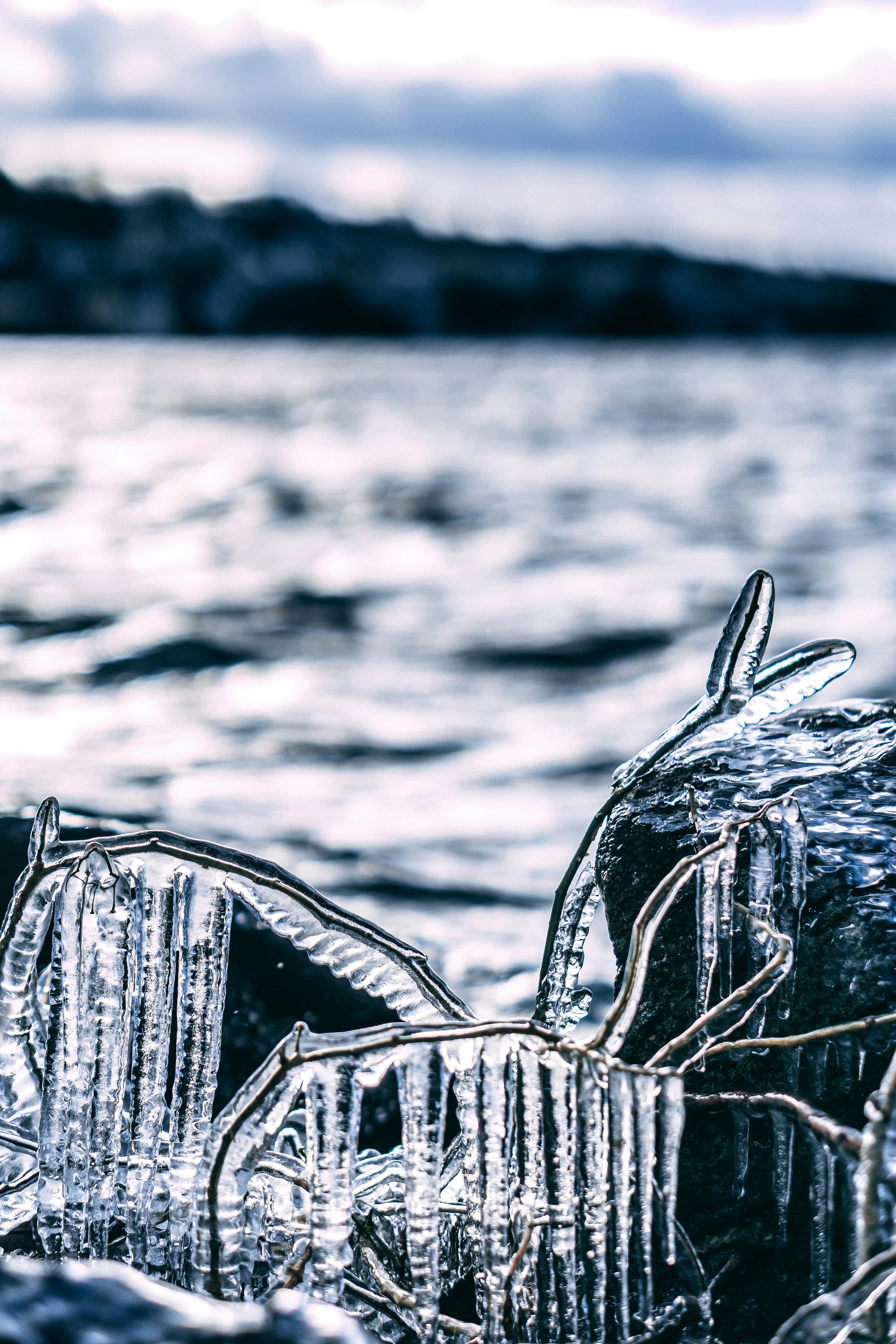
The next winter rune is Isa, or ice. With Nauthiz, we have the feeling we’re going to take action. Isa tells us something different.
It tells us that you’re frozen, you can’t move right now, you’re not going anywhere.
I live in Alaska, and I know that when the ground is covered in ice, and you can ice skate down the street, or the snow is five feet deep, you’re just gonna have to cancel your plans.
Isa deals with the tension of knowing that you’re not where you want to be, you’re trapped for now, and you can’t go anywhere. There’s nothing you can do to change the situation; you’re forced to rest.
But sitting with this discomfort, noticing it, feeling it, and letting it build – that is what motivates us to change it. It’s a time of building pressure even if there’s no release yet.
It’s not unusual to end up holding tension on this level for years, decades even.
Eihwaz. ay-haz. Death and Transformation.
Eihwaz is the rule of death and transformation. Most symbolic systems actually combine death and transformation into one maneuver (the same is true of Pluto in astrology and the Death card in Tarot).
In both cases, we’ve lost the old, we can’t go back, and the way that things were is no longer open to us. There’s a feeling of loss and grief and terror and confusion. We don’t know what’s next. There’s a change coming, and we can’t see around the corner. We’re up to our necks in the unknown.
And that’s how we transform. That’s when we make the jump.
That’s a lot of tension.
This is the culmination, the breaking point, the transition.
Another thing the Vikings understood well was sacrifice. In any transformation – we are sacrificing our old life, our old selves, our old relationships and dreams and ways of being – and there is grief in that, and loss.
But it is necessary for the next thing to come in.
In Nordic mythology, the All-Father Odin discovered the runes by “sacrificing himself to himself”. He hung himself for nine days and nine nights on the world tree, before he discovered the runes, and was able to bring them back to the community. It probably didn’t feel great.
Our culture generally underplays the loss that comes from resolving tension. If we are really going to bring the two sides together, something has to go – whether one of the things we are holding, or an entire way of being that made the opposition possible.
If our Viking friend, starving in the late winter, is to decide to risk the ice and deep snow to go hunting, he may well lose fingers, toes, or his life in the chase. But maybe it’s worth it.
Eihwaz asks us to do the math, make the choice, and make the sacrifice necessary to become something that can resolve the tension.
And perhaps on a higher level, Eihwaz demands that we focus on the things that don’t change, when everything else does. It’s only when we face annihilation that we can see what we really are.
And maybe that core, true self is the balance point of the tension.
Ingwaz. ing-wahz. Birth/Outcome
Ing represents probably my favorite point in the tension cycle, at least to be in, although it’s still not easy.
At this point, the change is mostly complete. You’ve seen what the need and the tension really is, you’ve gotten strong enough to hold it, you’ve made the sacrifice needed to resolve it, and you’ve stepped into transformation.
But the change is not quite complete. You’re still holding the tension.
Ing is a time just before things are done, when you’re 95% there, slowly tying off loose ends. Adding the finishing touches. Making sure the soup is fully cooked and the rolls are ready too.
In the tale of the Ugly Duckling, this is the point where the mis-named baby swan has been rejected by his community, survived the winter, roamed across the countryside, and spring has come again. But he still doesn’t know what he is. He can’t see himself yet. He hasn’t yet stepped into the new identity.
Which points out a key piece of both holding tension and the kind of transformations that resolve it.
It’s really not about the tension at all. It’s about who you have to be to hold it and resolve it. It’s about becoming. Identity. Growth.
And who you become in the process is arguably the most important part. Ing is like those slow months at the end of summer, as the cold sets in, when you wait for the almost ripe-but-probably-still-sour fruit to fully ripen.
It’s the time when you become a human who can hold your tension-transformation gracefully, wisely, kindly, and with a good sense of humor.
And when the transformation does arrive – it’s almost easy to miss. Because you have changed so much, now this is your reality.
Tension as a Process of Transformation
Maybe the revelation of the runes is that we don’t just HOLD tension. Tension asks something of us – it asks growth, becoming, transformation. It is a process that changes us, and through which we change our world.
It asks us not only to become someone strong enough to hold the poles, but someone with the humor, grace, and creativity to reconcile them. To transcend the tension.
But it takes a LONG time. So long, we often forget we are in a process of transformation at all. So long we forget that there is a resolution, and sometimes we lose our will to seek it.
Managing tension is a journey, a process, more than a point in time.
And the runes can help point to where we are in it.
Are you:
-
(Nauthiz/ Need) – Just realizing a need, and trying to identify what it really is and how bad you really want to change it?
-
(Isa/ Ice) – Stuck in the pain of not having it?
-
(Eihwaz/ Transformation) – At the point of transformation, facing the unknown and weighing the sacrifice?
-
(Ingwaz/ Outcome) – Slowly stepping into a new normal, a new identity, and trying to do it with integrity?
The tensions we hold DO resolve – but they are often part of a much deeper process than we give them credit for.
And there are maps to help us navigate.
Leave a Reply