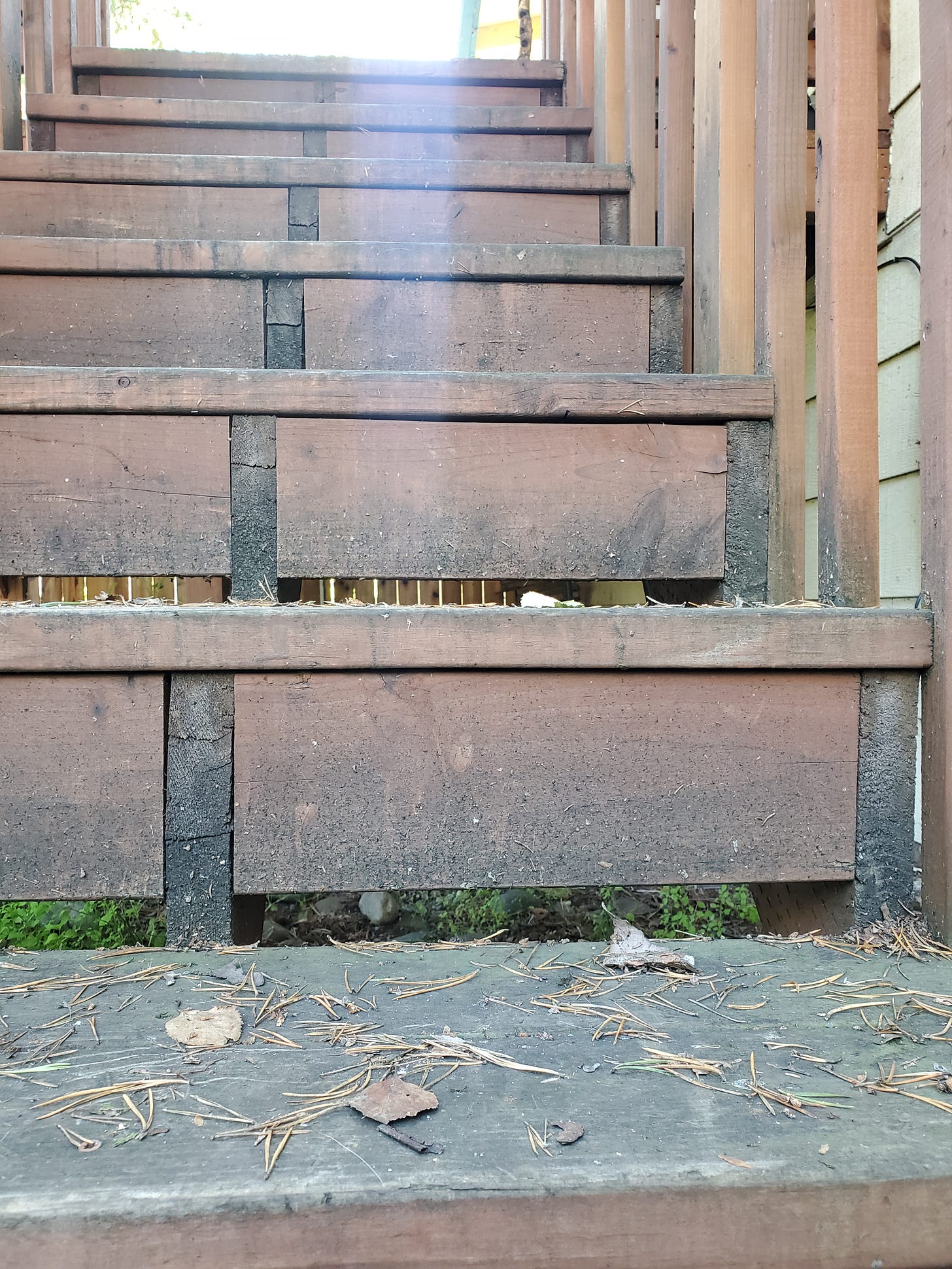
Doing the thing is hard.
Your nervous system starts screaming every time you head towards the unknown, the new, the creative, the wondrous.
Or it distracts you, comes up with 10 million excuses, demands clarity or certainty you can’t provide.
But you know that doing the thing is what stands between you and everything you want in life.
And you have to keep crossing into no-man’s land repeatedly. The space between what you know (that is safe and sucks) and what you long for (that is new, unknown, and dangerous).
The best way to deal with the terror and do it anyway is to take smaller steps.
How? How can you make steps small enough to be doable, when everything feels like a cliff?
How to Make Steps Smaller
I learned many of these ideas when my kid went to OT (Occupational Therapy).
OT has been variously described as the “art of getting people to do things they don’t want to do”, a good way to help you “get better at your occupation of being a human”, or a practice of “finding steps that are small enough for people to take”.
You see how this could be useful.
Identify the micro-steps that lead to a bigger step.
Write down all the micro-steps it takes to do a bigger/overwhelming task. Then work on a smaller skill that builds to a bigger one.
Potty training is a useful example here. It seems pretty obvious to us adults, but there are a ridiculous number of micro-skills you need to actually get to a toilet in time and have everything work properly.
For example, you have to notice the need, prioritize it, negotiate a pause to whatever you are doing, go to the toilet, open the door, close the door, undo your pants, aim whatever needs aiming, relax enough to actually do the thing, clean up after, redo your pants, wash your hands, open the door again, come back, and resume the prior activity. Phew.
And if any one of those steps goes sideways, someone is cleaning up a mess.
Most of our adult goals are actually a pile of micro-steps that we take for granted. These can be things like awareness of the problem, showing up, having conversations, sending a first message, writing down a list of questions, holding a pen.
The scarier the goal, the smaller steps need to be.
Then focus on an earlier stage in the process. Aim to develop each “muscle” you need to notice and do the micro-steps individually, and slowly stack them together. If it still feels too hard, look for more micro-steps.
What support do you need to do the thing?
We tend to think of support in terms of just knowing how or social “accountability”.
But in education it looks different. “I do, We do, You do” is a common pattern.
I do it. – If it’s too hard for you, just watch me do it. Mirror neurons actually help train the skill.
We do it. – Then once you see how I don’t die, we can do it TOGETHER.
Having someone else doing the same thing helps us coregulate our nervous systems. Our brains are going through the same motions, we are working on not freaking out together, it’s going to be okay.
This is one of the best things about classes, cohorts, coaches, and friends – when someone else does it with you, it unlocks things you couldn’t do alone.
You do it. – Finally, we gradually reduce the support you need to do it yourself. We slowly extend the time you can do it alone. We practice starting alone.
You can also reduce the types of support. For example, you might reduce verbal, physical, and visual help down to just verbal help.
Active Attunement – Importantly, growth is cyclical. Some days are great, some days feel like a regression. Even once you are doing things on your own, sometimes you’ll need more support again.
That is okay, essential, even, for real growth. It’s all part of the process.
Change things up.
Sometimes we get locked in to how horrifying something is in a certain environment or context.
But if we change it up, we can build the muscle to do the really hard thing someplace that isn’t as triggering.
Change the environment – Go someplace different. Do it in a different room, outside, in a closet, in the car. With the lights off. When it’s cold. Sometimes the shock of just walking into a different room or changing the lighting is enough to reduce the activation level.
Change your body – Go get grounded. Exercise, pace, dig in the dirt, play with your dog, take a shower, stretch, hang upside down. Then come back to it. Or stack it and do it while you’re doing the other thing.
Change the content – If a task feels like too much, try doing it in a similar situation that feels less risky. For example, writing felt terrifyingly vulnerable to me – but art felt doable. So I published art for several months instead, and it built my confidence that I could write visibly and not die.
Add play – This is huge for kids, and bringing in your inner child can be pretty helpful too. If you can integrate it into something fun and playful, part of a game, a way to improve your score, something you already love, it’s easier to do. You may not even notice doing it.
Celebrate It ALL
Celebrate the tiny steps.
Write down every time you show up for how long. Make a streak you don’t want to break. And reward yourself just for showing up.
Some days all you can do is stick a toe in the Forbidden Forest, but that’s what builds the muscle and the courage to actually go for a walk in there later.
Conclusion
Ultimately, building a business and life you love, making creative work that lights you up, building relationships that really matter – they’re all terrifying on some level.
They all require stepping into the unknown, the risky, over and over, where you know you will probably get hurt.
Taking smaller steps can mean the difference between 20 years of longing for change, and starting the first pebbles rolling of the avalanche that finally makes the difference.
Happy walking.
Leave a Reply