I had promised my son a fish for his 6th birthday. He had been saving money to help cover the cost for months, and was bouncing next to me on his tip toes with excitement.
But as I looked at the cart – packed full of random oddments I had never imagined a fish needed to survive: from tank to gravel to pump to food to decorations to netting to water conditioner – my stomach dropped.
The fish (a beautiful blue betta) was only $10.
But his basic fish accessories came in at over $200.
I could have just taken home Blue (the fish), some fish food, and popped him in a bowl, as people do. But that would have been condemning him to a short, miserable life.
If I wanted this fish to thrive, it was going to be a lot more expensive.
Likewise – we can survive a lot of tough conditions. But if we want to thrive, the environment plays a huge role. And building it right is a lot harder than it seems.
Space Travel
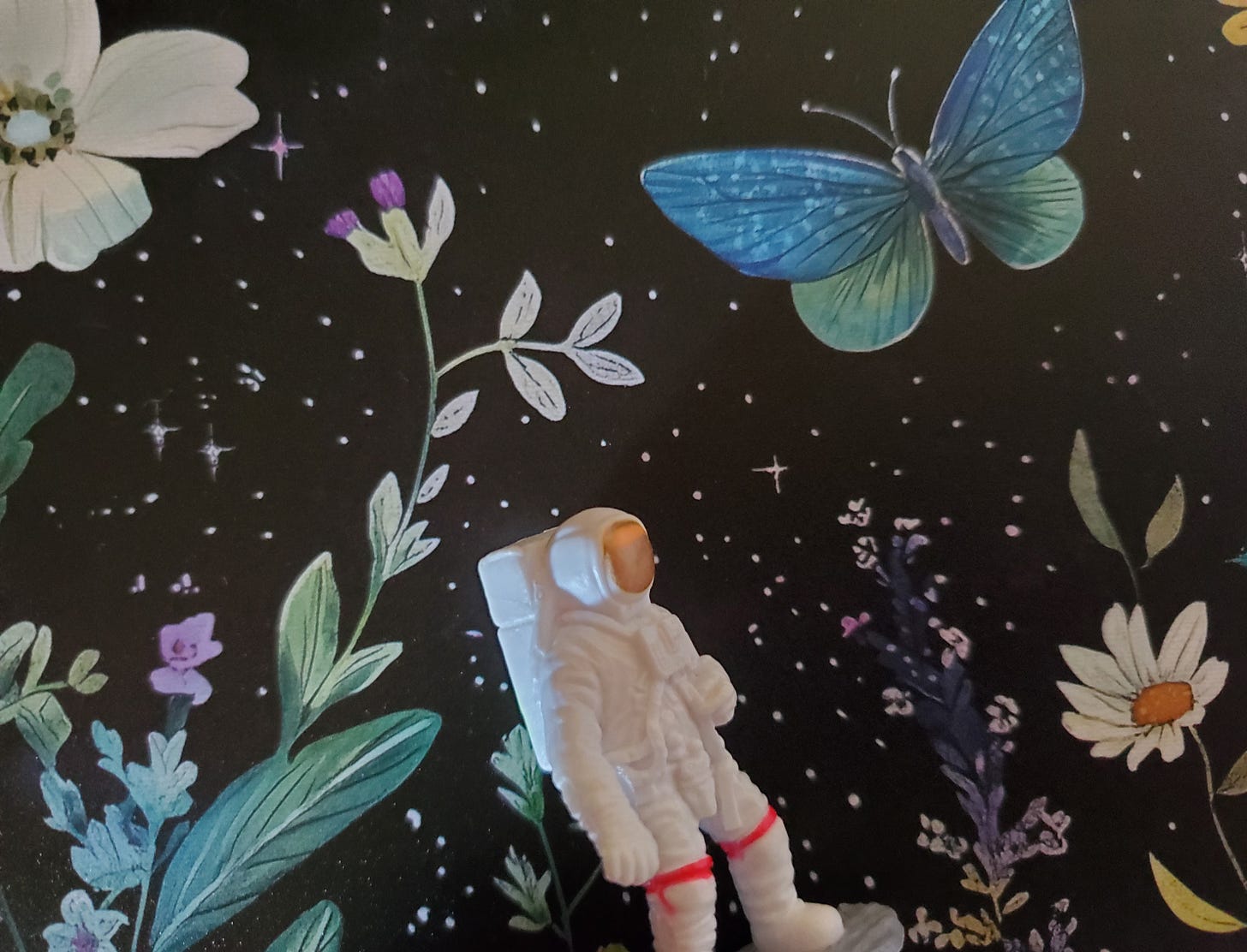
It’s a bit like space travel. Launching a man into space is, comparatively, easy. He might be pretty uncomfortable floating around in his tiny pod for a few days, but then he crashes back to earth, and that’s that.
But building a habitat in space for him, where he can sustain himself long term, is much more difficult.
The closest we have is the ISS, which is still uncomfortable, subjects astronauts to radiation and unexpected hazards of low gravity, and is not, frankly, an alternative for human life to thrive.
Something like building a habitat on the Moon or traveling to Mars is so difficult – not to send the people, but to engineer all the habitat details like gravity and radiation protection – that we haven’t done it yet.
The point here is that you can reach the goal. You can get to the top of the mountain. You can get rich or famous or make fulfilling work.
But if we want to thrive – we have to do the much harder work of building an environment that supports us. That can sustain the goal long-term.
Ancient Times
For most of our evolution, humans lived in small bands of other humans, most of whom they knew their whole lives.
They slept when they needed to, they ate (fairly little) when they could, they lived outside and got tons of exercise. They spent most of their time with their lifelong friends, staring at the quiet rhythm of the rain or the sway of tall grass in the wind.
They gorged on sweet fruits and meat when they could, because there were only a few fruit harvests and big game hunts a year.
Life was simple (and hard).
Now
Now we have enough food, and we don’t need to walk miles for it, so we’ve all grown pudgy, still eating like starving nomads.
The rapt attention we once paid to distant herds, crackling fires, and the stars is now spent on “urgent news disasters” and mindless short-form videos.
The tribe of our family and closest friends is being replaced by fewer and fewer people who know us well and more vague strangers on the internet.
We have better health care, and we’re less likely to freeze or be trampled by a woolly mammoth.
We’re safer – and more stressed, distracted, and isolated.
Our conditions have changed.
While there are advantages – survival is easier – most of the safeguards for our sanity and nervous systems are gone as well.
There is less community, nature, exercise, and peace.
How Did We Get Here?
Obviously, the problems we most want to cure are the “bleeding neck” ones – the most painful. Same for our ancestors.
So they worked to cure starvation, disease, exposure, random tramplings.
They industrialized.
Now, we have a world with less starvation, fewer diseases, warmer housing, and no woolly mammoths.
But the cost came in ways we didn’t expect.
The Cost of Progress
We’ve lost our peace, our attention, our community, our connection.
The serenity of long walks, tending a crackling campfire, staring at the stars, watching the sunrise, or waiting hours for the fish to bite are things we long for.
The ability to focus for a long time, remember complex information, tell deep stories, think deep thoughts, feel nuance – all are being drown out under the onslaught of content screaming for our attention.
Fewer and fewer people around us have known us all our lives. They wouldn’t risk theirs to save us, and they don’t reach out to hold us when we’re down – we’re mostly just strangers passing in the night.
Without quiet and depth, we’re losing our ability to meaningfully understand and care for each other, and we’re losing our connection with ourselves and the world around us.
The Conditions to Thrive
We’ve lost the environment our hearts, brains, and nerves were designed for – the wild steppe and woolly mammoths are no more. Just like my friend Blue the Betta fish lost his rice paddy.
Our task is to recreate those conditions that we need to thrive, in the environment we are in.
And it’s a mistake to think it’s easy.
The basics can mean survival, but they are not enough to thrive. We can’t just make a couple tweaks and continue on our current trajectory.
We need to rewrite the rules for what we think we need, at the foundation, for a “good life”.
I don’t have all the answers.
But I suspect our grocery list of necessities includes:
- peace, stillness, and focused attention
- quiet, soothing time in nature
- regulating exercise and handwork
- love and people who really know us
- understanding, both for ourselves and others
- connection with each other, the world, and ourselves
- freedom and autonomy
- curiosity and growth
Many of these things never mattered to our ancestors, cause they had them. And they had bigger problems.
Now we have food, shelter, medical care – the basic conditions for survival.
But if we are going to build lives in which we can thrive, that feel good on the inside, we are going to need to build a much bigger fish tank.
Leave a Reply